Picture a familiar scene. A learning session wraps up. Learners are packing their bags. The facilitator catches the energy in the room – engaged, responsive, a few particularly good moments of discussion. She makes a mental note: that activity worked. At the next planning meeting, she recommends keeping it in. The team agrees. The module stays as designed.
Nothing about this is incorrect. Experienced facilitators read rooms well. Their observations are real evidence. The problem is not that they trusted their instinct – the problem is that nobody asked whether that instinct was pointing in the right direction, or whether something else in the room might have told a different story.
What anecdotes can and cannot do
In education and skilling programmes, the evidence that practitioners actually have access to is almost always some combination of facilitator observation, direct learner feedback, and feel. This is the nature of the work. Formal outcome data such as assessments, longitudinal tracking, structured pre-post measures may be expensive, slow, and often not designed for the kind of micro-decisions programme teams make every day: whether to change a session format, drop an activity, add a reflection prompt, or restructure how a module is sequenced.
So practitioners rely on what they have. And what they have is usually anecdotes.
Anecdote is not the enemy of good evidence-based practice. In many programme contexts, it is the most honest and available form of evidence practitioners have. The goal is not to replace it. The goal is to know when it is enough on its own, and when it needs something alongside it.
The trouble is not the anecdote itself. A facilitator or an observer who notices that learners in three consecutive sessions struggled with the same transition point has seen something real and important. That observation is worth acting on. The trouble is when a sample data point becomes the basis for a decision that affects every session, every facilitator, every cohort of learners going forward.
The question is not whether anecdote is valid. It is. The question is whether it is sufficient. And that depends entirely on the scale and permanence of the decision being made.
The triangulation habit
In our recent work facilitating a capacity-building engagement for a learning experience team at a large education-focused organisation, this gap surfaced almost immediately. The team was reflective and experienced. They were not making careless decisions. But when we asked them to trace a recent programme decision back to its evidence base, most of the chains ended at a single source: one facilitator’s or observer’s observation, one round of learner feedback collected in one site visit, one conversation in a team meeting.
The response to this finding is often to collect more data. More feedback forms, more structured observations, more reporting requirements. That instinct is understandable but it misses the point. More than the volume of evidence, the problem is the habit of checking what you already have before acting on any single piece of it.
Triangulation, in its simplest form, is just asking three questions before making a decision:
- Source. Did this come from one person or several? One site or multiple? Would a different observer have seen the same thing?
- Form. Is this observation, self-report, or outcome data? Each has different blind spots. Self-report, for instance, tends to overstate engagement and understate difficulty. It is useful but it needs a check.
- Timing. Is this a pattern that has held across multiple sessions and cycles, or did it happen once? A single session that went badly is not the same signal as a consistent pattern across a quarter.
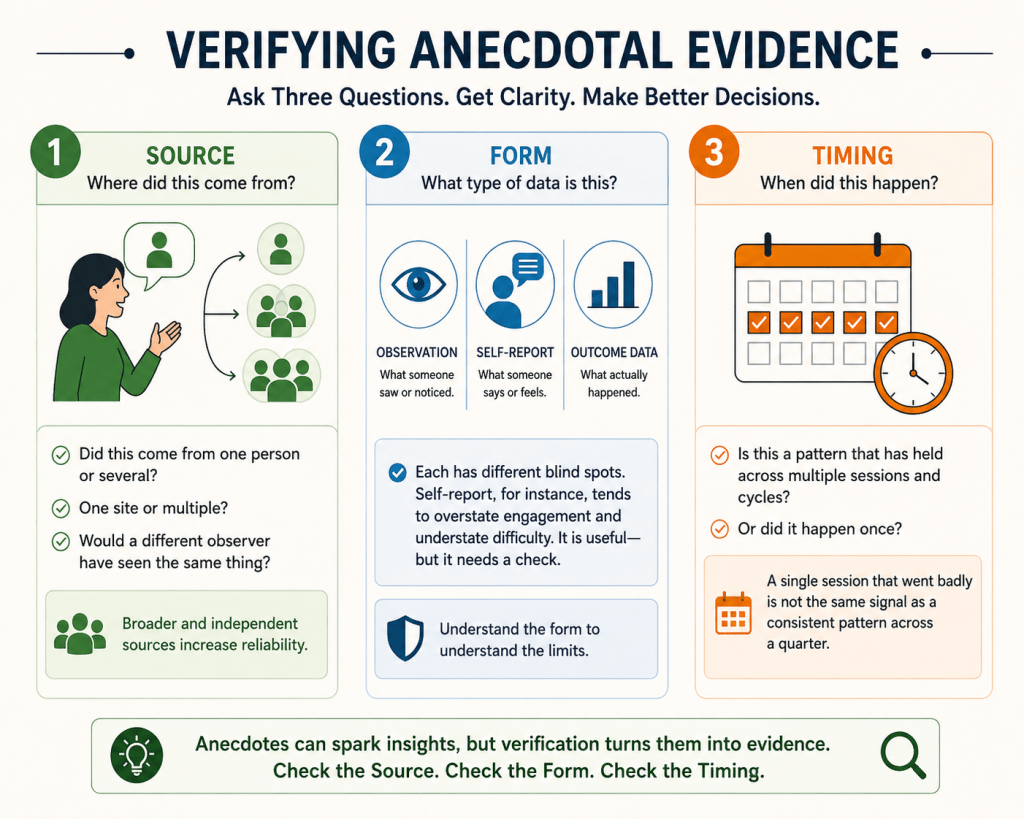
These are not methodological tests. They are questions that take thirty seconds to ask and that significantly reduce the risk of acting on evidence that is thinner than it appears.
What changes when you ask the questions
The facilitator in our opening scene does not need to stop trusting her instinct. She needs to add one step: before recommending that the activity stays, she asks herself whether anything else she has seen or heard points in the same direction. If the answer is yes, if the Learning Experience coordinator saw the same thing at a different site, if learner feedback from that cycle independently mentioned the activity as memorable. Then the recommendation is on solid ground. If the answer is no, the recommendation becomes more tentative: this seems to be working, but we have only seen it from one angle. Let us watch it for another cycle before committing.
That shift from acting on a single signal to pausing to check for corroboration is small in practice and significant in effect. It does not require new data systems. It does not require a MEL team’s intervention. It requires a habit, and habits can be built.
In the teams we work with, we have started treating triangulation not as a methodological principle but as a professional reflex. The question is not “do we have evidence?” Most teams do. The question is “do we have more than one independent signal pointing in the same direction?” If not, the decision is worth holding a little more lightly.