
The limits of a binary UDISE+ ramp indicator for understanding accessibility
Abstract
UDISE+ data indicates that nearly 80% of all schools in India have ramps for children with disabilities, suggesting significant progress on inclusive infrastructure. This article examines whether the data collection instrument can support that claim. Question 2.15 of the UDISE+ Data Capture Format asks schools to report ramp availability as a binary yes or no, despite the same format acknowledging (in Section 2.2) that schools may comprise multiple building blocks. This creates a reporting dilemma for school heads whose campuses have partial ramp coverage, with consequences that extend to inspection compliance, Samagra Shiksha funding allocation, and the ability of civil society organisations to track progress on inclusive education. Analysis of UDISE+ 2024-25 microdata reveals that of the 3,07,199 schools (~21%) that report having no ramp, 89,884 are multi-block campuses serving 54,264 CWSN students who require ramp access. These are schools where the binary question makes it impossible to distinguish between genuinely inaccessible campuses and those where partial compliance could not be recorded. The article argues that block-level data capture is necessary for any reliable assessment of school accessibility.
A Reassuring Headline
UDISE+ (Unified District Information System for Education Plus) is India’s national school education database, covering over 14 lakh schools, 1 crore teachers, and 24 crore students from pre-primary through higher secondary. It is the primary data source for education planning, resource allocation under Samagra Shiksha, and monitoring of school infrastructure across the country. The consolidated UDISE+ 2025-26 data presents an encouraging picture on school accessibility. Large states such as Maharashtra, Odisha, Tamil Nadu, and Madhya Pradesh report that ~95% or more of their schools have ramps for children with disabilities. North-eastern states show a larger infrastructure gap, but the national trend line points towards steady compliance with accessibility requirements. Interestingly, across the country, 88.2% of government schools report having an access ramp while only 60.4% of Unaided private schools report the same.
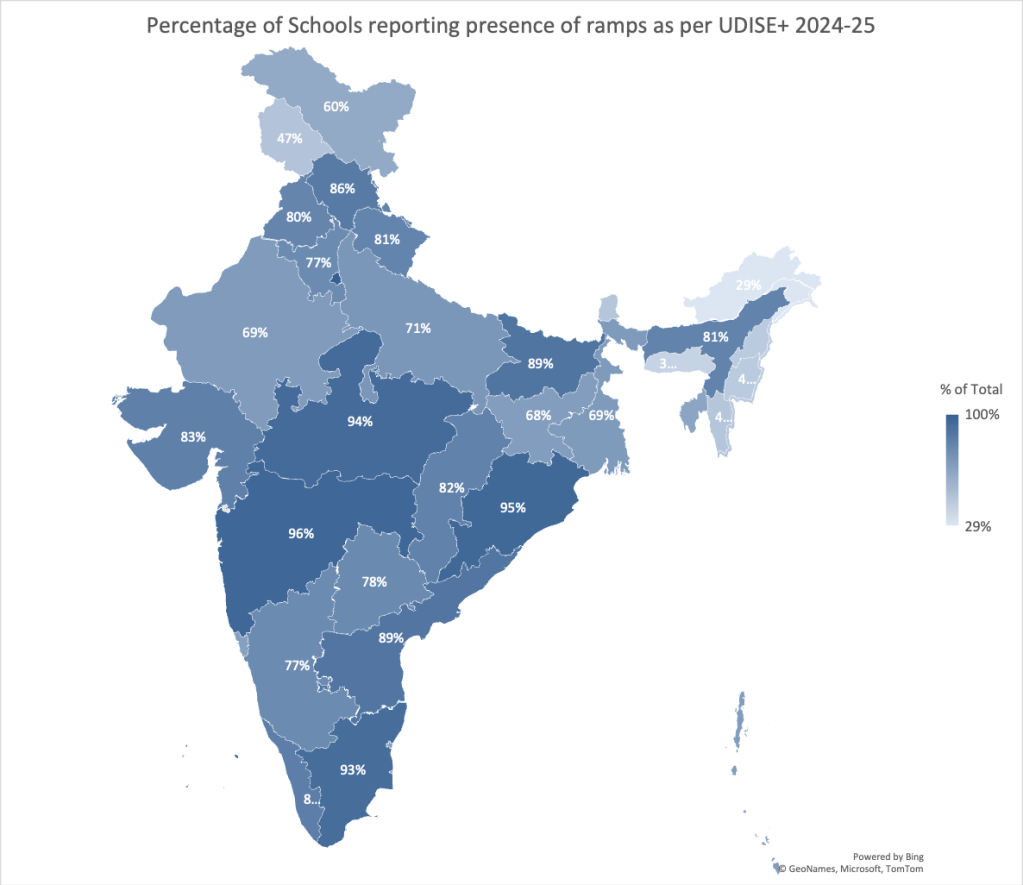
For anyone tracking inclusive education in India, these numbers suggest that the physical barriers to schooling for children with special needs (CWSN) are falling, though not uniformly across the country, nor uniformly across school management types. UDISE+ classifies students with disabilities under 21 categories. Of these, at least four describe conditions that make ramp access essential for a child to enter a school building: locomotor disability, cerebral palsy, dwarfism, and muscular dystrophy. A fifth category, multiple disabilities, may also require ramp access depending on the individual child’s condition. The presence or absence of a ramp is not a matter of convenience for these children. It determines whether they can physically enter the space where learning happens. UDISE+ tracks two related but distinct indicators related to ramps: whether a ramp exists, and whether that ramp has a handrail. This article concerns itself with the more basic of the two – question 2.15, on the presence of a ramp – and does not refer to the handrail indicator.
Though the headline numbers look fairly encouraging, the question is whether the data that produces them actually measures what it claims to measure.
Whose Access Depends on the Answer
The children for whom this question matters most are already among the most marginalised in the education system. A child with a locomotor disability in a rural school faces compounded barriers: distance to school, social stigma, inadequate support systems, and the fundamental question of whether the school building is physically accessible. When we report that nearly 4 out of 5 schools have ramps, we make an implicit promise to that child and their family: the infrastructure is in place. If the data behind that claim is unreliable, the promise is hollow, and the child remains invisible in the aggregate.
The structural issue here is not an absence of political will or funding for inclusive infrastructure. It is something more fundamental: the design of the data collection instrument itself. When a survey question cannot capture the reality it seeks to measure, every downstream decision built on that data inherits the distortion. The children who bear the consequences are those who are already navigating a system that was not designed with them in mind.
One Question, Many Realities
To understand the problem of the ramp indicator and how it could provide insufficient data, it helps to visualise a school campus. A school is not a single building. It comprises one or more building blocks housing classrooms, and as the school’s student strength and category increase (from primary to upper primary, secondary, higher secondary), so does the number of blocks needed to accommodate additional classrooms, laboratories, staff rooms, and other facilities. A school campus, then, is a collection of blocks.
UDISE+ acknowledges this. Section 2.2 of the Data Capture Format asks schools to report the number of active building blocks on their campus. Across the country, schools report anywhere from a single block to more than twenty-five.
Now consider question 2.15 in the same format: “Whether ramp for disabled children to access school building exists? – Yes / No.”
This question treats the school as a single structure. It does not account for the fact that a campus may have multiple blocks, some of which require ramps (because they are at an elevated level) and others which do not (because they are at ground level). It does not allow the respondent – typically the headmaster or principal – to indicate partial compliance: that some elevated blocks have ramps while others do not.
The complex, differentiated reality of a school campus is compressed into a single binary response.
Picture a high school with five buildings. Two are at ground level, so no ramp is needed to enter them. The other three are raised slightly off the ground and need a ramp to access. Of those three, two already have a ramp built. One does not. Now the principal has to answer a single question: does this school have a ramp, yes or no? How does the principal respond?
If they answer “Yes,” they risk being questioned during inspections for the block that lacks a ramp, and face potential penal action for misrepresenting their school’s accessibility status. If they answer “No,” four of five blocks are in fact accessible – through ramps or through being at ground level – and the school is recorded as non-compliant despite 80% of its blocks meeting the accessibility standard. Neither response captures reality. The principal is caught between misrepresentation and under-reporting.
The consequences of this ambiguity extend beyond reporting accuracy into funding and resource allocation. Under Samagra Shiksha, budgets are allocated for ramp construction as part of the inclusive education and CWSN component (Department of School Education and Literacy, 2018). If the example school reported “Yes” in the previous year, a request for funds to build a ramp for the remaining block would be flagged as a discrepancy: the data already shows the school has ramps. If the school reported “No,” it appears on the list of schools without an inclusive environment, and internal authorities question why two of the three blocks that need ramps already have them. The data format creates a situation where the school faces scrutiny regardless of how it reports, and where a genuine infrastructure gap cannot be addressed through the normal funding channel because the instrument cannot record it.
The scale of this ambiguity is not trivial. According to UDISE+ 2024-25 microdata published by the Ministry of Education (Department of School Education and Literacy, 2025b), 89,884 schools across the country report having more than one building block on their campus. These schools collectively serve 54,264 CWSN students whose disabilities require ramp access to school buildings.
These 89,884 schools represent approximately only 6% of India’s 14,71,473 schools where this discrepancy might play out. But 3,07,199 schools (~20%) report not having a ramp.
The question, however, is not one of proportion. A single incorrectly recorded data point can determine whether a child in a school gains or is denied physical access to a classroom. The inclusive education component of Samagra Shiksha exists precisely for these children, and a data instrument that cannot accurately capture which schools need support undermines the mechanism designed to provide it.
What Should Change
Four specific actions follow from this analysis.
For the Ministry of Education and the UDISE+ survey design team: Question 2.15 should be restructured to capture block-level information on ramp availability, consistent with the multi-block reality already acknowledged in Section 2.2 of the same Data Capture Format. A block-wise response – recording the number of blocks that require ramps and the number that have them installed – would capture ground reality far more accurately than a campus-level binary. The internal inconsistency between what Section 2.2 acknowledges (that schools have multiple building blocks) and what Section 2.15 ignores (that ramp availability may vary across those blocks) is a design flaw that the Ministry’s own data architecture has the information to resolve.
For policymakers and programme administrators: Aggregate compliance figures on ramp availability should be interpreted with caution until the data collection instrument is reformed. Funding decisions under Samagra Shiksha’s inclusive education component should build in a mechanism for schools to report and request support for partial compliance in multi-block campuses, rather than treating each school as either fully compliant or fully non-compliant.
For civil society organisations and advocacy groups: UDISE+ ramp data is widely used to assess progress on accessibility commitments and to hold governments accountable for inclusive infrastructure. The ambiguity in question 2.15 means that aggregate compliance figures may present either a rosier or bleaker picture than reality warrants. Organisations relying on this data to measure the effectiveness of advocacy for inclusive learning environments should treat ramp compliance figures as indicative rather than definitive, and should advocate for the data instrument reform that would make reliable tracking possible.
For researchers and evaluators: This is a case study in how the design of a data instrument shapes what we can know about equity. The gap between what question 2.15 asks and what school-level reality demands should prompt us to interrogate other binary questions in large-scale datasets with similar care. When a single data point influences whether a child with a disability can access education, the precision of the question is not a technical detail. It is an equity concern.
Limitations and Assumptions
- Since UDISE+ data is self-reported by the school and certified by the Head Master/Principal, and subsequently verified by Block, District, and State-level MIS officials, this article assumes the underlying data is reasonably accurate. It does not rule out reporting errors, inconsistent interpretation of question 2.15 across schools, or verification lapses at any stage of the process.
- This analysis relies on UDISE+ 2024-25 microdata for the school and block-level figures, while state-level compliance percentages referenced elsewhere are drawn from the UDISE+ 2025-26 consolidated report. The two are not from the same reference year, and 2025-26 school-level microdata was not yet available for cross-verification at the time of writing.
- The five-block scenario in this article is illustrative and not drawn from a specific verified case. It is used to demonstrate a plausible reporting dilemma given what UDISE+’s own architecture (Section 2.2 on building blocks) makes possible, not to claim this is how any particular school has actually responded.
- UDISE+ does not capture whether individual blocks within a school are at ground level or elevated, nor which specific blocks have ramps. This article’s argument about undercounting or overcounting rests on inference from the structure of the data collection format rather than on directly observed block-level ramp data, which does not exist in the public dataset.
- The 54,264 CWSN students figure represents students in multi-block schools who fall under disability categories for which ramp access is likely necessary. It does not confirm that these specific students are being denied access, only that they attend schools where the ramp indicator cannot reliably describe their situation.
Disclosure
The central argument and analysis in this article are the author’s. Claude (Anthropic) was used to refine the structure and language of the draft. The author has no conflicts of interest to declare.
References
Department of School Education and Literacy, Ministry of Education, Government of India. (2018). Samagra Shiksha: An integrated scheme for school education – Framework for implementation. https://samagra.education.gov.in/docs/Framework_IISE%20_F.pdf
Department of School Education and Literacy, Ministry of Education, Government of India. (2024). Unified District Information System for Education Plus (UDISE+): Data Capture Format for academic year 2024-25. https://udiseplus.gov.in
Department of School Education and Literacy, Ministry of Education, Government of India. (2025a). Unified District Information System for Education Plus (UDISE+): Data Capture Format for academic year 2025-26. https://udiseplus.gov.in
Department of School Education and Literacy, Ministry of Education, Government of India. (2025b). UDISE+ 2024-25: School-level microdata [Data set]. https://udiseplus.gov.in
Department of School Education and Literacy, Ministry of Education, Government of India. (2025c). Guidelines for filling up the UDISE+ Data Capture Format. https://udiseplus.gov.in
Department of School Education and Literacy, Ministry of Education, Government of India. (2026). Report on Unified District Information System for Education Plus (UDISE+) 2025-26. https://dashboard.udiseplus.gov.in

 Peraivu Koodam Foundation